Talent Market Analysis: The Complete Guide to Smarter Tech Hiring in 2026
Hiring often starts with a job description.
That is frequently too late.
Before deciding where to advertise a role, which sourcing channels to use, or how many recruiters to assign to a search, there is a more fundamental question to answer:
Does the talent market support the hiring plan in the first place?
A talent market analysis helps answer that question.
It examines the external market for the people and skills an organization wants to hire. A good analysis shows where relevant talent is located, how large the realistic talent pool may be, what employers are competing for the same people, what compensation the market expects, and which parts of the hiring brief make a search easier or harder.
For technology hiring, this is particularly valuable.
The World Economic Forum expects technology-related roles such as AI and machine learning specialists, big data specialists, fintech engineers, and software and application developers to remain among the fastest-growing jobs through 2030. At the same time, it estimates that 39% of workers’ existing skills will be transformed or become outdated during the 2025-2030 period.
That creates an uncomfortable reality for employers:
A hiring plan that looked reasonable last year may already be poorly calibrated today.
Talent market analysis replaces assumptions with evidence.
This guide explains what talent market analysis is, what information it should contain, how to perform one step by step, which data sources to use, how to evaluate talent availability and competition, and how to turn market intelligence into better hiring decisions.
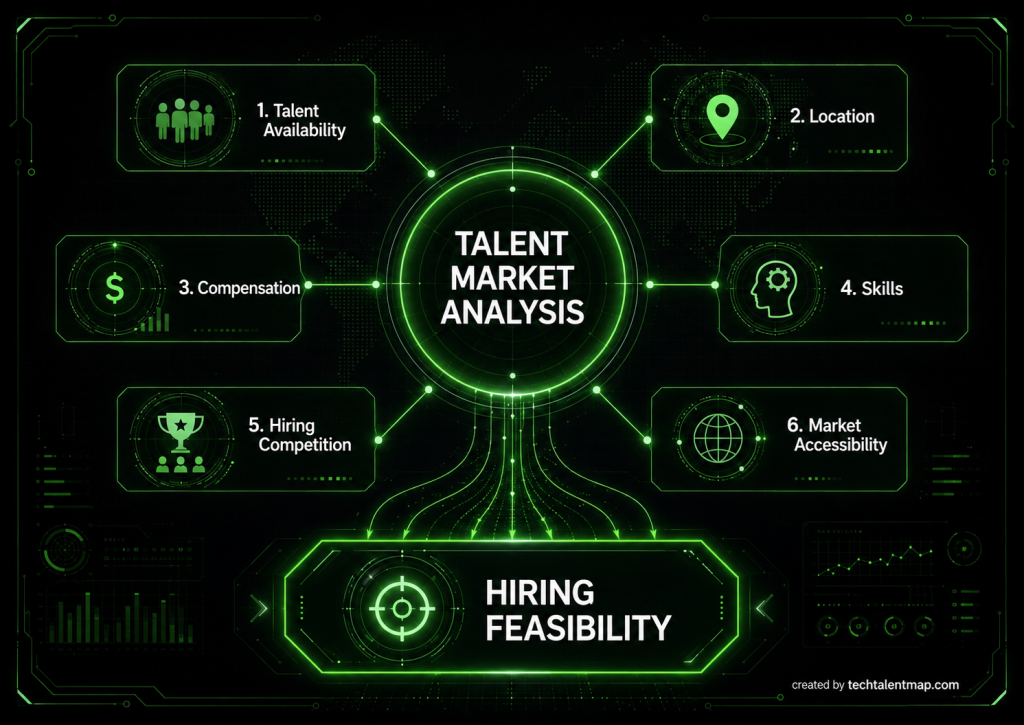
Table of Contents
- What Is a Talent Market Analysis?
- Why Talent Market Analysis Matters in 2026
- Talent Market Analysis vs. Talent Market Intelligence
- Talent Market Analysis vs. Talent Mapping
- Talent Market Analysis vs. Labor Market Analysis
- When Should You Conduct a Talent Market Analysis?
- What Should a Talent Market Analysis Include?
- The Talent Market Analysis Workflow
- How to Conduct a Talent Market Analysis Step by Step
- How to Calculate a Realistic Talent Pool
- How to Measure Talent Supply and Demand
- How to Analyze Competitor Hiring Activity
- How to Use Salary Benchmarking in Talent Market Analysis
- How to Compare Hiring Locations
- A Practical Tech Hiring Example
- How Talent Market Analysis Changes Recruitment Strategy
- Common Talent Market Analysis Mistakes
- Data Sources for Talent Market Analysis
- Free vs. Paid Talent Market Data
- How AI Can Support Talent Market Analysis
- How Often Should Talent Market Analysis Be Updated?
- From Talent Market Data to Hiring Decisions
- Frequently Asked Questions
- Final Thoughts
What Is a Talent Market Analysis?
Talent market analysis is the systematic evaluation of the external market for a specific role, skill set, profession, or workforce requirement in order to understand talent availability, location, compensation, competition, demand, and hiring feasibility.
In practical terms, it answers questions such as:
- How many people could realistically perform this job?
- Where are they located?
- Which cities or countries have the strongest talent pools?
- Which employers currently employ them?
- How many other companies are trying to hire similar talent?
- What salary range is competitive?
- Which skills are scarce?
- How mobile are candidates?
- How difficult is the role likely to be to fill?
- Would changing location, compensation, seniority, or requirements improve the hiring outcome?
This makes talent market analysis different from simply searching LinkedIn and counting profiles.
A database may tell you that 8,000 people match a broad job title.
It does not automatically mean that 8,000 people represent realistic candidates.
Some may have the wrong seniority. Others may lack a critical skill. Some may work in industries from which they are unlikely to move. Others may require compensation far beyond the approved budget. Many will not be open to the required location or working model.
The objective is therefore not to discover the largest possible talent pool.
It is to understand the realistic addressable talent market for the hiring requirement.
That distinction matters.
HireVue’s early framework for talent market analysis made a similar point by defining the available talent market more broadly than people currently holding an identical job. A useful analysis may include workers in adjacent occupations, comparable industries, or roles with transferable skills.
Modern talent market analysis extends this further by combining talent availability with salary data, skills, geography, competitive hiring activity and other market signals.
Why Talent Market Analysis Matters in 2026
Recruitment has traditionally been reactive.
A manager gets approval for a role.
A job description is written.
The position is posted.
Recruiters begin sourcing.
Only several weeks later does the organization discover that the hiring assumptions were unrealistic.
Perhaps the salary is 20% below the market.
Perhaps nearly all candidates with the required skills are concentrated in another city.
Perhaps five large competitors started hiring the same profile.
Perhaps the combination of technologies in the job description exists in only a tiny number of professionals.
Perhaps the company requires five days per week in an office located far from the relevant talent pool.
At that point, valuable time has already been lost.
Talent market analysis moves market validation before recruitment execution.
That is increasingly important because technology labor markets are changing quickly.
Eurostat reported that approximately 10.45 million people worked as ICT specialists across the European Union in 2025, representing 5% of total EU employment. ICT specialist employment has increased substantially over the past decade, but that growth is not evenly distributed across countries. Sweden, Luxembourg and Finland have particularly high concentrations of ICT professionals relative to their overall workforces.
At the same time, different technical skills are moving at very different speeds.
The World Economic Forum identifies AI and big data, networks and cybersecurity, and technological literacy among the fastest-growing skills.
A generic statement such as “Europe has plenty of developers” is therefore almost useless.
The question is whether there are enough Senior Java Engineers with payments experience who can commute to a particular location for three days per week at the salary your company is willing to pay.
That is a talent market analysis question.
Talent market analysis reduces hiring risk
A good analysis can reveal problems before they become failed searches.
It may show that:
- the required talent pool is too small;
- the salary range is not competitive;
- a neighboring market offers better talent availability;
- one required skill is eliminating most otherwise suitable candidates;
- remote hiring would dramatically expand the addressable market;
- another job title would improve sourcing coverage;
- competitors are hiring aggressively;
- candidates typically expect a different working model;
- the original hiring timeline is unrealistic.
None of these insights guarantee a successful hire.
They do, however, improve the quality of the decisions made before and during the search.
Talent Market Analysis vs. Talent Market Intelligence
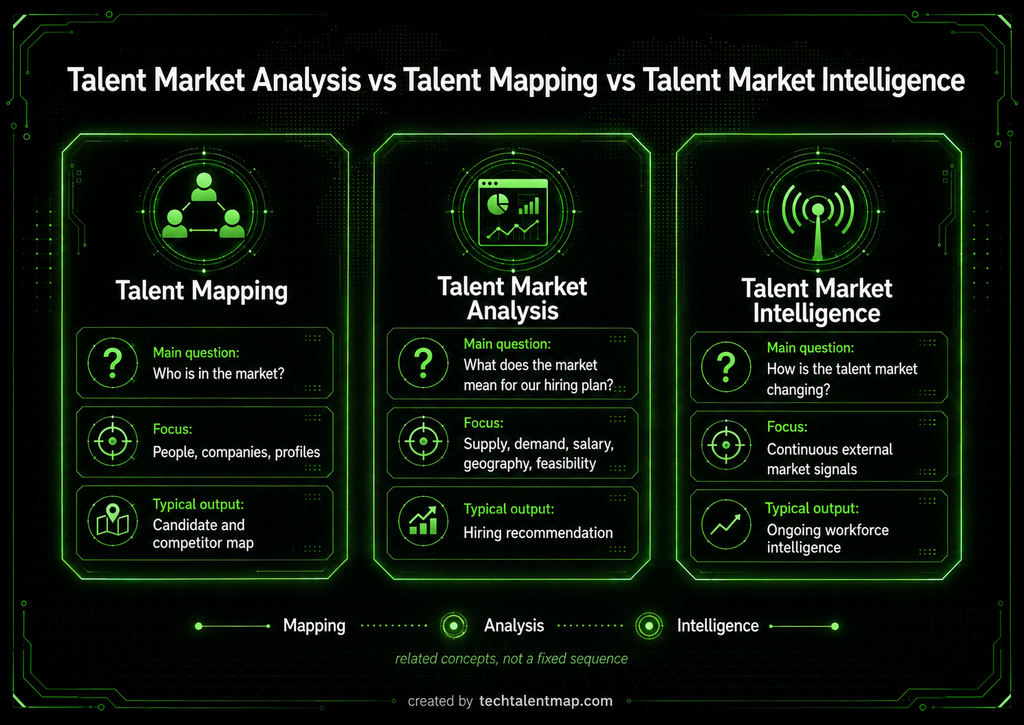
The terms talent market analysis and talent market intelligence are often used interchangeably, but there is a useful distinction.
Talent market analysis is usually a defined research exercise.
Talent market intelligence is the broader capability of continuously gathering, interpreting and applying external workforce information.
Beamery describes talent market intelligence around questions such as where candidates with particular skills are located, which compensation is competitive, which skills are rising or declining, and how competitors are hiring or restructuring.
A company might therefore maintain ongoing talent market intelligence across multiple functions while conducting a specific talent market analysis for a new engineering hub.
For example:
Talent market intelligence
A company continuously monitors AI engineering demand across Europe.
Talent market analysis
The company compares Paris, Berlin, Warsaw and Amsterdam to decide where to build a 30-person machine learning team.
Think of intelligence as the ongoing information system and analysis as a structured investigation used to answer a particular hiring question.
Both are valuable.
But organizations do not need a sophisticated intelligence platform before they can start making better hiring decisions.
A well-designed individual analysis can already reveal significant opportunities.
Talent Market Analysis vs. Talent Mapping
Talent mapping usually focuses more directly on identifying the people and organizations that make up a talent market.
A talent map may include:
- target companies;
- candidate profiles;
- job titles;
- reporting structures;
- relevant experience;
- skill combinations;
- likely succession candidates;
- competitor teams.
Talent market analysis takes a broader view.
It may use talent mapping as one of its inputs, but also considers:
- supply and demand;
- salary benchmarks;
- geographic concentration;
- market growth;
- hiring competition;
- candidate mobility;
- notice periods;
- location feasibility;
- sourcing difficulty.
A simple way to distinguish them is:
Talent mapping asks: Who is in the market?
Talent market analysis asks: What does this market mean for our hiring plan?
For strategic hiring, the two approaches are often strongest when combined.
Talent Market Analysis vs. Labor Market Analysis
Labor market analysis generally looks at employment conditions across broader populations, occupations, sectors, regions or economies.
Governments, economists and policymakers may study:
- employment rates;
- unemployment;
- workforce participation;
- vacancies;
- wage trends;
- occupational shortages;
- migration;
- education;
- productivity.
Talent market analysis applies similar thinking to a much narrower business problem.
The European Labour Authority, for example, compares vacancies as a proxy for unmet labor demand with unemployed workers as a proxy for potential supply when evaluating occupational shortages and surpluses.
An employer can apply a more granular version of the same supply-demand logic to a specific hiring requirement.
Instead of asking:
“Is there an ICT labor shortage in this country?”
the employer asks:
“How much demand exists for cloud security engineers with AWS, Kubernetes and financial-services experience within commuting distance of our office?”
Labor market information provides context.
Talent market analysis converts that context into a hiring decision.
When Should You Conduct a Talent Market Analysis?
Not every vacancy needs a full market study.
For highly repeatable, well-understood roles, recruiters may already have enough historical data to calibrate the search.
Talent market analysis becomes particularly valuable when uncertainty or hiring risk is high.
1. Before opening a new office or technology hub
Choosing a location based primarily on tax, office costs or executive preference can create expensive recruitment problems later.
A location analysis should evaluate talent before a commitment is made.
2. Before hiring a new or unfamiliar role
If an organization has never hired an AI Infrastructure Engineer, for example, internal compensation bands and recruiting expectations may be poor benchmarks.
3. Before launching high-volume hiring
A small market may support five hires but not fifty.
High-volume hiring requires understanding whether the talent supply is deep enough to support sustained recruitment.
4. When a role has remained open for too long
A difficult search may be a recruiting execution problem.
It may also be a market problem.
Talent analysis helps distinguish the two.
5. When offer acceptance is low
Repeated rejected offers can indicate compensation gaps, stronger competitors, location problems or candidate expectations that were not understood when the role was opened.
6. When entering a new country
International expansion introduces additional variables including labor costs, employment regulation, language, mobility and local market structure.
7. When building workforce plans
HireVue recommends evaluating external talent supply alongside workforce planning rather than waiting until individual vacancies become urgent.
This is particularly useful for business-critical roles with long hiring lead times.
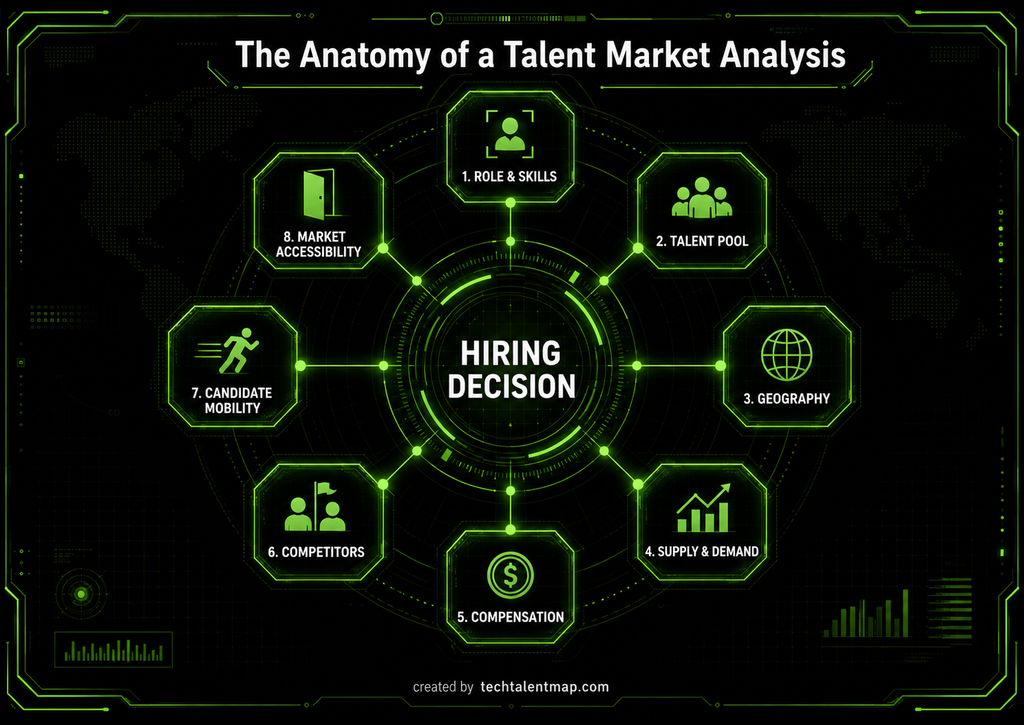
What Should a Talent Market Analysis Include?
There is no universal template.
The correct scope depends on the hiring decision being made.
However, most useful talent market analyses contain the following components.
Role and Skills Definition
Start with the role.
Not the job title.
Titles are inconsistent across companies and countries.
A “Platform Engineer” at one company may be called:
- DevOps Engineer;
- Site Reliability Engineer;
- Cloud Engineer;
- Infrastructure Engineer;
- Production Engineer.
A market analysis based on one title may significantly underestimate the available talent.
Instead, define the role through:
- required capabilities;
- technologies;
- level of responsibility;
- years or type of experience;
- industry knowledge;
- certifications;
- language requirements;
- management scope.
This creates the foundation for every later calculation.
Talent Pool Size
The talent pool should estimate how many professionals could plausibly satisfy the requirement.
This should not be treated as an exact census.
Most private talent databases contain incomplete, duplicated, outdated or inferred information.
Instead, talent pool size is best used as a decision-making estimate.
A useful report may distinguish between:
Broad pool
Professionals with generally relevant backgrounds.
Qualified pool
Professionals matching the main skills and seniority requirements.
Realistic addressable pool
Qualified professionals who are also compatible with location, compensation and other important constraints.
That third number is usually the one that matters most.
Geographic Talent Distribution
A market may contain enough talent overall but distribute it poorly for your hiring model.
Analyze:
- countries;
- cities;
- metropolitan areas;
- regional clusters;
- remote talent;
- commuting radius.
Geographic concentration can affect sourcing efficiency, compensation, employer competition and relocation requirements.
For technology roles, location differences can be substantial.
Eurostat’s 2025 figures show Germany employing roughly 2.3 million ICT specialists, the largest absolute number in the EU, while smaller countries such as Sweden and Finland have a higher concentration of ICT professionals relative to total employment.
Absolute size and talent density therefore answer different questions.
Talent Supply and Demand
A large pool does not necessarily mean an easy market.
Imagine two cities.
City A
30,000 relevant professionals
2,000 competing vacancies
City B
10,000 relevant professionals
150 competing vacancies
City A has three times as much talent.
But City B may provide a much healthier supply-demand ratio.
This is why talent market analysis should consider both candidate supply and employer demand.
Useful demand signals include:
- current job postings;
- number of employers hiring;
- hiring growth;
- repeated vacancies;
- expanding teams;
- funding events;
- new office openings;
- workforce reductions;
- changes in job-posting volume.
Salary and Compensation Benchmarks
Compensation can determine whether a theoretically available talent pool is actually accessible.
Benchmarking should ideally consider:
- base salary;
- variable compensation;
- equity;
- bonuses;
- benefits;
- geographic differences;
- seniority;
- company type;
- employment model.
For example, the U.S. Bureau of Labor Statistics reports a May 2024 median annual wage of $133,080 for software developers and projects software developer employment growth well above the average occupation through 2034.
That is useful macro context.
It is not enough to price a particular Senior Backend Engineer in San Francisco.
A strong market analysis narrows compensation data to the relevant role, level, geography and employer market.
Competitor Hiring Activity
Your competitors for talent are not necessarily your commercial competitors.
A bank recruiting cloud engineers may compete for candidates with:
- software companies;
- consultancies;
- cybersecurity vendors;
- fintech businesses;
- cloud providers;
- large retailers;
- government technology teams.
Competitor analysis should therefore identify companies that employ or recruit similar talent regardless of industry.
Analyze:
- who employs the target profiles;
- who is currently hiring them;
- how frequently roles appear;
- what locations competitors use;
- salary information where available;
- remote or hybrid policies;
- employer value propositions;
- hiring velocity.
Candidate Mobility and Notice Periods
Talent supply is dynamic.
A pool of 5,000 relevant professionals means something very different if employees frequently change employers than if average tenure is six years and notice periods last three months.
Useful mobility indicators include:
- average tenure;
- recent job changes;
- typical notice period;
- relocation willingness;
- remote-work expectations;
- visa constraints;
- local labor-market mobility.
Market Accessibility
Two equally qualified candidates may not be equally accessible.
Constraints can include:
- language requirements;
- security clearance;
- office attendance;
- work authorization;
- industry-specific experience;
- compensation;
- certifications;
- willingness to relocate.
Market accessibility is the bridge between theoretical talent supply and realistic talent supply.
Hiring Difficulty
The final report should bring the evidence together into a practical assessment.
For example:
| Dimension | Market Condition |
|---|---|
| Talent supply | Moderate |
| Hiring demand | High |
| Salary competitiveness | Below market |
| Geographic concentration | High |
| Skill scarcity | High |
| Candidate mobility | Moderate |
| Overall hiring difficulty | High |
The objective is not to invent a scientific-looking score.
The objective is to help stakeholders understand why the search may be difficult.
The Talent Market Analysis Workflow
A simple way to structure the analysis is through six questions:
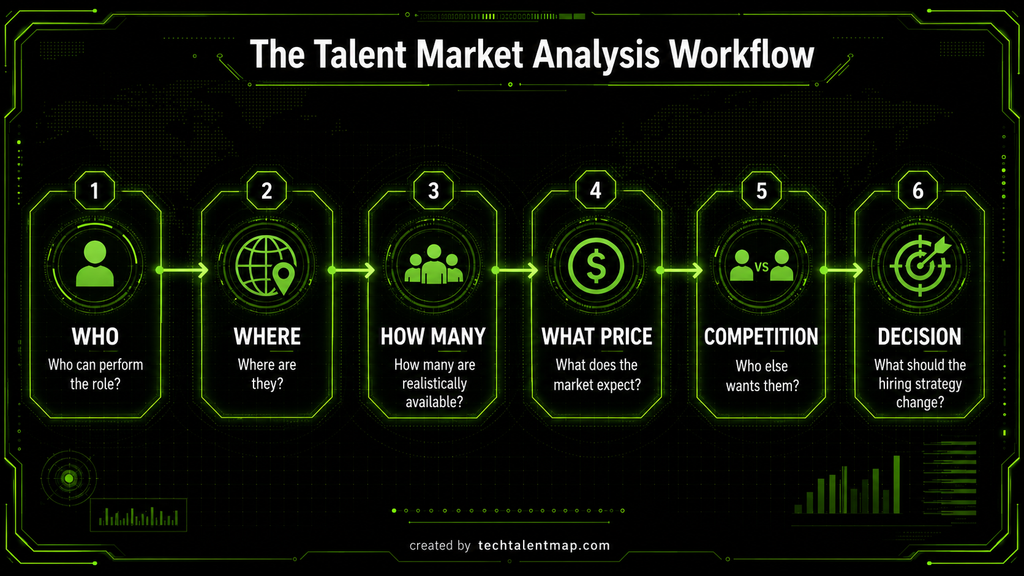
1. WHO?
Who can realistically perform the role?
Define titles, skills, seniority, adjacent profiles and transferable experience.
2. WHERE?
Where is that talent located?
Compare countries, cities, clusters and remote markets.
3. HOW MANY?
How large is the realistic talent pool?
Separate broad market size from genuinely addressable candidates.
4. WHAT PRICE?
What does the market expect?
Analyze salary, compensation and location differences.
5. WHO ELSE WANTS THEM?
How competitive is employer demand?
Identify employers, vacancies and hiring trends.
6. WHAT SHOULD WE CHANGE?
This is the most important question.
Market research without a decision is just interesting information.
Every talent market analysis should end with recommendations.
How to Conduct a Talent Market Analysis Step by Step
Step 1: Define the Hiring Question
Do not begin by collecting data.
Begin with the decision.
Examples:
- Can we hire 20 DevOps Engineers in Prague?
- Should our next engineering hub be in Poland or Portugal?
- Why has our Senior Data Engineer role been open for 90 days?
- Is our €70,000 salary ceiling realistic?
- Would remote hiring materially improve the search?
- Which European market is strongest for German-speaking SAP talent?
The narrower the decision, the more useful the analysis.
A report trying to explain “the European tech talent market” may contain hundreds of statistics while answering none of these questions.
Step 2: Translate the Job into Searchable Skills
Break the hiring brief into components.
Example:
Senior Data Engineer
Core:
- Python
- SQL
- data pipelines
- cloud infrastructure
- ETL/ELT
Preferred:
- AWS
- Snowflake
- Airflow
- dbt
- Kafka
Experience:
- 5+ years
- production-scale data systems
- SaaS or fintech experience
Location:
- Berlin
- hybrid, three days per week
Compensation:
- €85,000 to €100,000
Now challenge every constraint.
Is five years genuinely required?
Could GCP experience transfer to AWS?
Does the person need fintech experience or merely experience with regulated data?
Could two office days work instead of three?
Every unnecessary requirement shrinks the market.
Step 3: Define the Realistic Talent Pool
Build the pool in layers.
Layer A: Direct matches
Professionals currently doing essentially the same job.
Layer B: Adjacent titles
People doing comparable work under different titles.
Layer C: Transferable profiles
Professionals whose skills could translate into the role.
This layered approach avoids two common errors:
- underestimating the market by using an overly narrow title;
- overestimating it by including anyone with one matching keyword.
The original HireVue methodology also recommends considering equivalent roles across other industries and related occupations rather than restricting analysis to exact job matches.
Step 4: Estimate Talent Availability
Now estimate how much relevant talent exists.
Do not stop at the database result count.
Apply the actual constraints.
Suppose your search identifies:
12,000 broadly relevant profiles.
After seniority:
5,500
After required technical skills:
2,600
After geographic constraints:
1,300
After industry requirement:
700
After working-model requirement:
400
After compensation compatibility:
Potentially 250-350.
The hiring market is not 12,000 people.
Your realistic market may be closer to 300.
This is one of the most valuable outputs a talent market analysis can produce.
Step 5: Analyze Geographic Distribution
Plot where qualified profiles are located.
Look for:
- dominant talent hubs;
- secondary cities;
- emerging clusters;
- lower-competition markets;
- cross-border remote opportunities.
Do not assume the largest city is automatically the best location.
A smaller market may combine adequate supply with substantially lower competition.
For European technology hiring, country-level statistics can provide a starting point. Eurostat shows meaningful differences in both the absolute number and workforce concentration of ICT specialists across the EU.
Then narrow the analysis to the exact skills you require.
Step 6: Measure Hiring Demand and Competition
Next, study the demand side.
For each market, consider:
Relevant talent pool
versus
Active employer demand
A rough ratio can be useful:
Talent Market Pressure = Relevant Job Demand / Addressable Talent Supply
This should not be presented as universal scientific truth.
Use it as a comparison tool.
Suppose:
| Location | Addressable Talent | Relevant Open Roles | Relative Pressure |
|---|---|---|---|
| Berlin | 3,500 | 700 | High |
| Warsaw | 2,800 | 280 | Moderate |
| Bucharest | 1,900 | 140 | Lower |
| Amsterdam | 1,600 | 420 | Very high |
Berlin still has the largest talent pool.
Bucharest may nevertheless be easier to recruit from.
Supply without demand data tells only half the story.
Step 7: Benchmark Compensation
Use multiple data sources whenever possible.
Compensation datasets often disagree because they measure different populations.
One source might represent advertised salary bands.
Another might reflect employee-reported compensation.
Another may measure payroll.
Another may overrepresent large technology companies.
Instead of treating one number as truth, build a range.
For example:
| Source | Median / Midpoint |
|---|---|
| Source A | €74,000 |
| Source B | €81,000 |
| Source C | €78,000 |
| Live vacancies | €75,000-€90,000 |
You might conclude:
Competitive market range: approximately €78,000-€88,000
Then compare this with the approved budget.
The objective is not false precision.
It is understanding whether your compensation is approximately:
- below market;
- market-aligned;
- above market.
Step 8: Analyze Candidate Mobility
Look beyond static headcount.
A market with high mobility may provide more recruiting opportunity than a larger but less dynamic one.
Consider:
- recent employer changes;
- average tenure;
- market layoffs;
- company closures;
- mergers;
- funding events;
- return-to-office policies;
- likely notice periods.
Candidate movement can create temporary hiring windows.
A large competitor announcing layoffs can materially change talent availability.
So can a major employer opening a new office.
Talent markets move.
Your analysis should recognize that.
Step 9: Compare Hiring Locations
If multiple locations are possible, build a scorecard.
For example:
| Factor | Weight |
|---|---|
| Talent availability | 30% |
| Skill fit | 20% |
| Compensation | 15% |
| Employer competition | 15% |
| Language | 5% |
| Candidate mobility | 5% |
| Business environment | 5% |
| Scalability | 5% |
Then score each market.
The weights should reflect the actual hiring requirement.
A support center may prioritize language and scale.
An AI research team may prioritize depth of specialized talent.
A startup may prioritize cost.
A regulated business may prioritize industry experience.
There is no universal “best country for tech talent.”
There is only the best market for a particular hiring problem.
Step 10: Turn Findings into Recommendations
The final step separates useful analysis from a data dump.
Recommendations might include:
- increase base salary from €80,000 to €90,000;
- remove unnecessary industry experience;
- expand search radius to another city;
- allow remote hiring;
- target adjacent job titles;
- prioritize competitors with relevant talent;
- launch sourcing before the formal vacancy opens;
- adjust expected time-to-fill;
- change seniority;
- create a relocation package;
- split one difficult role into two more available profiles.
A strong recommendation should connect directly to evidence.
For example:
Finding: Requiring Kafka reduces the qualified market by approximately 45%.
Recommendation: Treat Kafka as preferred rather than mandatory and assess transferable streaming experience during interviews.
That is actionable talent intelligence.
How to Calculate a Realistic Talent Pool
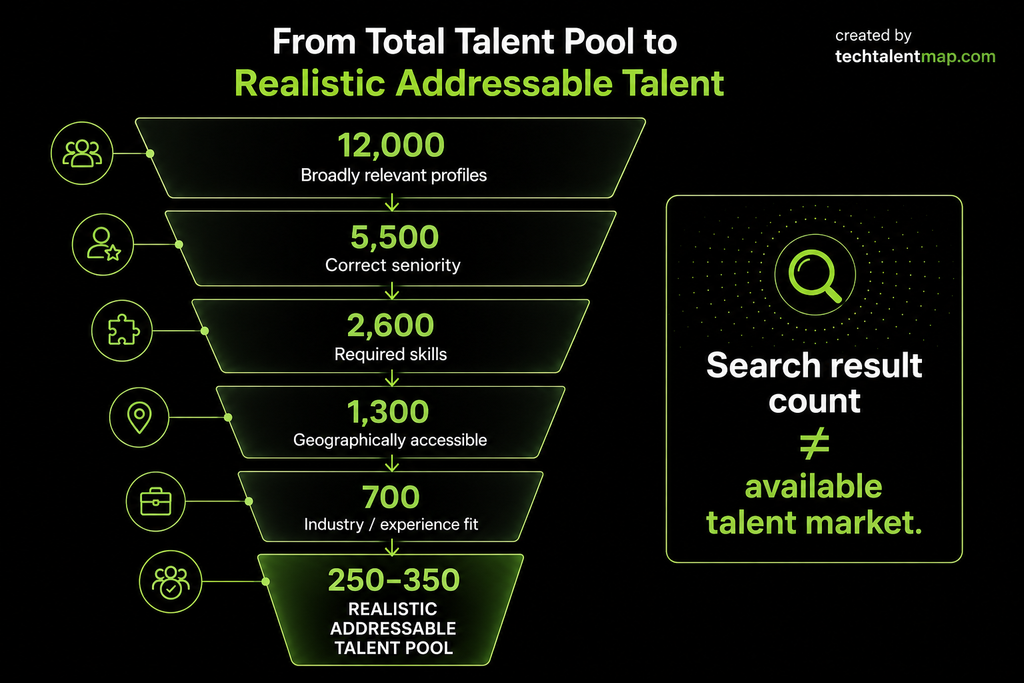
Talent pool estimates are often misunderstood.
Search tools encourage users to treat profile counts as market size.
They are not the same thing.
A useful model is:
Total Potential Pool × Qualification Rate × Accessibility Rate × Compensation Fit = Realistic Addressable Talent Pool
Suppose you estimate:
10,000 professionals with broadly relevant backgrounds.
50% meet seniority requirements.
60% match the core technical skills.
50% are geographically accessible.
70% fall within plausible compensation parameters.
The rough addressable market becomes:
10,000 × 0.50 × 0.60 × 0.50 × 0.70 = 1,050 people
That still does not mean 1,050 people will apply.
Some will not move.
Some will not respond.
Some are happy in their current roles.
Some recently started a new job.
The addressable market simply estimates the population worth considering.
Separate must-haves from preferences
One of the fastest ways to discover artificial scarcity is to calculate the market after every requirement.
Example:
| Requirement | Remaining Pool |
|---|---|
| Backend engineers | 8,400 |
| Senior level | 4,100 |
| Java | 2,700 |
| Kubernetes | 1,550 |
| Payments experience | 690 |
| German language | 210 |
| Within commuting range | 83 |
Suddenly everyone understands why the role is difficult.
The analysis also reveals which requirement creates the largest bottleneck.
That gives hiring managers something concrete to discuss.
How to Measure Talent Supply and Demand
Talent markets behave like other markets.
Availability matters.
Demand matters.
Price matters.
But measuring these precisely is difficult because no single dataset captures the whole market.
The European Labour Authority uses vacancies and unemployment as proxies when evaluating broader occupational shortages and surpluses.
At company level, recruiters can combine more granular indicators.
Supply indicators
- professional profiles;
- occupational employment statistics;
- graduates;
- relevant university programs;
- migration;
- adjacent occupations;
- current candidate databases;
- past applicants.
Demand indicators
- live vacancies;
- unique employers hiring;
- vacancy growth;
- repeat postings;
- funding;
- expansion;
- employer headcount trends.
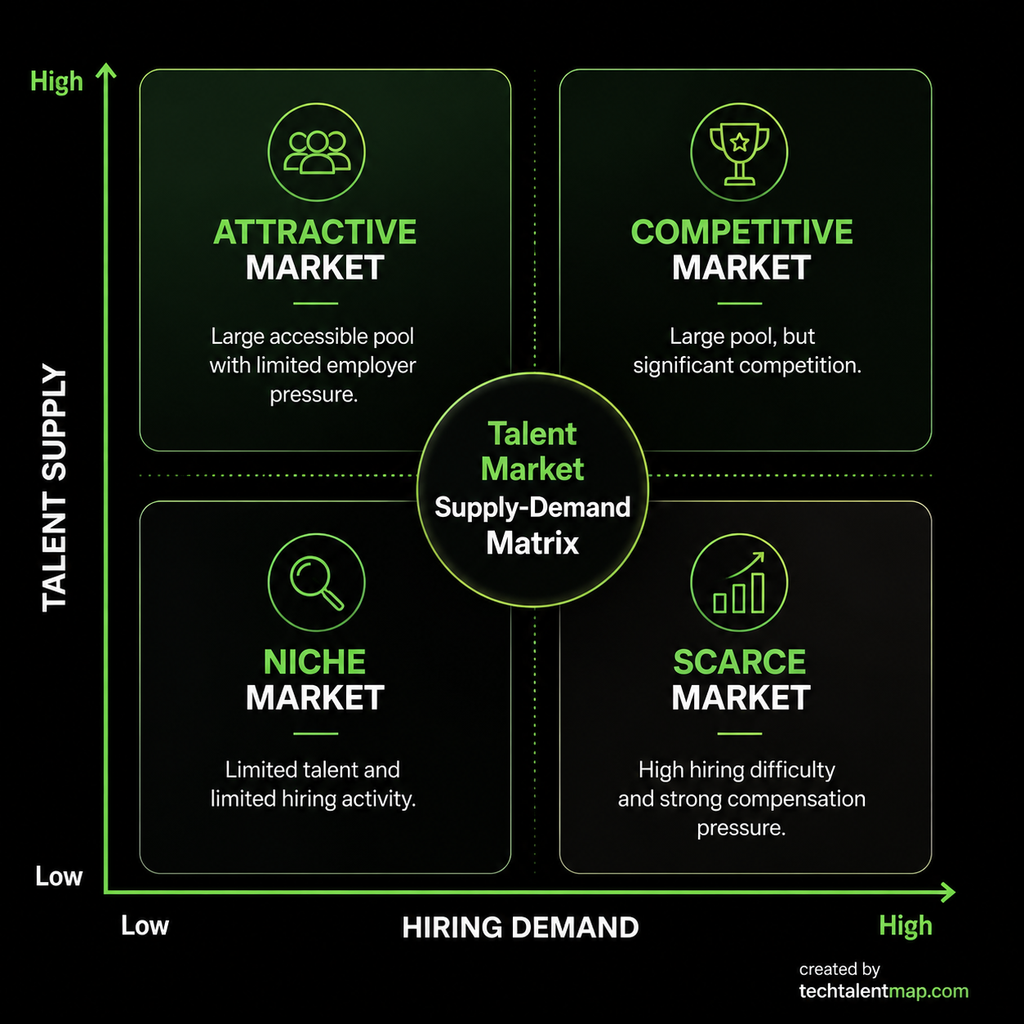
Supply-demand interpretation
High supply + low demand
Potentially attractive hiring environment.
High supply + high demand
Large but competitive market.
Low supply + low demand
Small specialist market.
Low supply + high demand
Potentially very difficult hiring environment.
The important point is that talent pool size should never be interpreted in isolation.
How to Analyze Competitor Hiring Activity
Competitor analysis should start with talent competitors, not business competitors.
Ask:
Where could our ideal candidate work instead of joining us?
For a cybersecurity engineer, the answer may include banks, consultancies, software vendors, telecoms, defense companies and cloud providers.
Then examine:
Current hiring volume
How many relevant vacancies does each company have?
Hiring direction
Are they expanding engineering, AI, security or another function?
Location strategy
Are they hiring in the same cities?
Compensation
What salary information is visible?
Employment model
Remote, hybrid or on-site?
Talent concentration
Which employers currently employ the largest number of relevant professionals?
Talent flows
Where do people join from?
Where do they go next?
A company repeatedly losing engineers to the same competitor has learned something useful about its market.
Talent movement can reveal competitors that a conventional market analysis might miss.
How to Use Salary Benchmarking in Talent Market Analysis
Salary benchmarking is not simply finding an average salary online.
Averages can be deeply misleading.
A useful benchmark should match as many of these dimensions as possible:
- role;
- skill set;
- seniority;
- location;
- industry;
- company size;
- employment model;
- compensation structure.
Consider two Senior Software Engineers.
One works on standard business applications.
The other builds low-latency distributed systems for a quantitative trading firm.
Their job titles may be identical.
Their talent markets are not.
Use ranges instead of false precision
A range is usually more credible than claiming a role is worth exactly €87,450.
Segment the market where useful:
Lower quartile
Candidates moving into the level or working for lower-paying employers.
Market midpoint
Typical competitive compensation.
Upper quartile
Scarce profiles, high-paying industries or premium employers.
Salary is part of market accessibility
If market compensation is €90,000-€110,000 and your maximum is €75,000, your practical talent pool may be far smaller than your profile search suggests.
That is why compensation belongs inside talent market analysis rather than being treated as a separate HR exercise.
How to Compare Hiring Locations
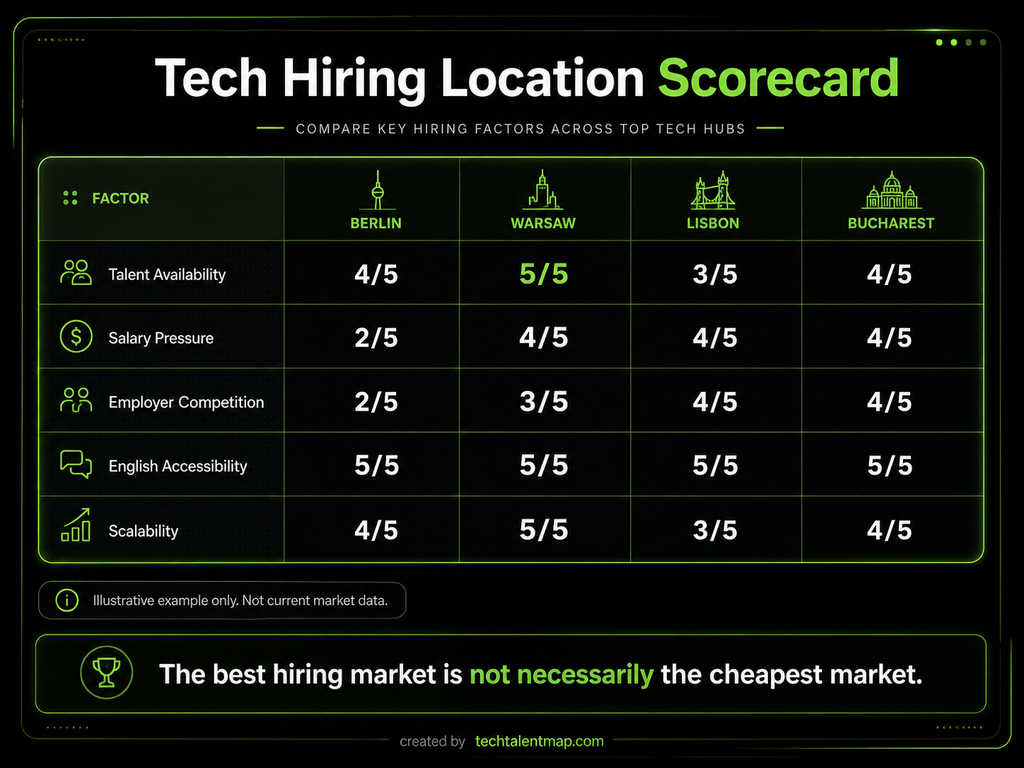
Location analysis is one of the most powerful applications of talent market intelligence.
Imagine that an organization needs 25 cloud engineers.
The question is not:
Which country has the cheapest engineers?
The correct question is:
Which market provides the best combination of relevant talent availability, quality, cost, accessibility, competition and scalability?
A useful comparison might include:
| Factor | Poland | Germany | Portugal | Romania |
|---|---|---|---|---|
| Relevant talent supply | High | Very high | Moderate | High |
| Compensation | Moderate | High | Moderate | Moderate |
| Employer competition | High | Very high | Moderate | Moderate |
| English availability | High | High | High | High |
| Scalability | High | Very high | Moderate | High |
These are illustrative labels, not current market findings.
A real analysis would need role-specific data.
That caveat matters.
A country may be excellent for Java developers but weak for a niche enterprise application.
Likewise, national averages can hide substantial city-level differences.
Do not confuse cheap with attractive
Low salaries often attract attention during location decisions.
But hiring cost is not salary alone.
Consider:
- recruiter effort;
- time-to-fill;
- vacancy cost;
- retention;
- relocation;
- management complexity;
- legal structure;
- failed hiring attempts.
A more expensive market with deeper talent availability may produce a lower total hiring risk.
A Practical Tech Hiring Example
Consider a fictional SaaS company planning to hire:
10 Senior Java Engineers
Requirements:
- Java
- Spring Boot
- microservices
- AWS
- five years of experience
- English
- hybrid working
Management initially chooses Munich.
Why?
The company already has an office there.
That is an operational reason.
It is not yet a talent-market reason.
Phase 1: Measure Munich
The analysis finds:
- strong overall software engineering talent;
- significant enterprise technology presence;
- high employer competition;
- relatively high salary expectations;
- candidates dispersed across the wider region;
- hybrid requirement limiting candidates outside commuting distance.
The search is feasible.
But potentially expensive.
Phase 2: Test alternative markets
The company compares:
- Munich;
- Berlin;
- Warsaw;
- Kraków;
- Prague.
For each market it measures:
- approximate Java talent pool;
- seniority;
- cloud experience;
- salary;
- active vacancies;
- leading employers;
- candidate mobility;
- expected hiring difficulty.
Phase 3: Identify the constraint
AWS reduces the market significantly.
However, many candidates have Azure or GCP plus strong cloud-native architecture experience.
The engineering team confirms that AWS itself is teachable.
Phase 4: Recalculate
Changing AWS from mandatory to preferred expands the addressable pool.
Meanwhile, Warsaw shows:
- strong Java availability;
- lower salary expectations than Munich;
- substantial technology employment;
- meaningful competition, but less compensation pressure.
Phase 5: Make the decision
The company does not necessarily abandon Munich.
Instead it might decide:
- hire three senior leaders in Munich;
- recruit the broader engineering team in Warsaw;
- remove AWS as a hard requirement;
- open sourcing four months before planned headcount growth.
That is what good talent market analysis should produce.
Not merely information.
A different hiring plan.
Planning a difficult tech hire?
Before launching the search, validate the market. A role-specific tech talent market report can help you understand talent availability, salary expectations, competition and location feasibility before recruiting begins.
How Talent Market Analysis Changes Recruitment Strategy
The analysis should influence execution.
Here are some of the most common changes.
Sourcing strategy
Instead of searching only the obvious titles, recruiters can target adjacent roles and companies identified during analysis.
Location
Recruitment may expand into stronger secondary markets.
Job requirements
Low-value constraints can be removed.
Compensation
Salary bands can be corrected before candidates start rejecting offers.
Hiring timeline
Stakeholders can establish realistic expectations.
Recruiter capacity
A very small or competitive market may justify more sourcing resources.
Employer positioning
Competitor research can reveal why candidates may choose another employer.
Workforce planning
Scarce roles can be identified months before they become urgent vacancies.
IBM includes regular talent market analysis as part of a broader talent acquisition strategy, alongside recruiting metrics, candidate feedback, sourcing performance and continuous process improvement.
That is the larger objective.
Market analysis should become part of how hiring decisions are made, not a document forgotten after one meeting.
Common Talent Market Analysis Mistakes
1. Starting with the data instead of the decision
A huge report is useless if nobody knows what decision it supports.
Start with the hiring question.
2. Treating LinkedIn profile counts as exact market size
Professional databases are valuable research tools.
They are not censuses.
Use estimates, triangulation and ranges.
3. Searching only one job title
Titles vary dramatically.
Search through skills, adjacent roles and responsibilities.
4. Ignoring employer demand
A large pool can still be brutally competitive.
Always examine supply and demand together.
5. Using generic salary averages
A national software engineer average may be irrelevant for a senior cybersecurity specialist.
Benchmark the real profile.
6. Treating all requirements as fixed
Market analysis should challenge the hiring brief.
If the market is too small, ask which constraints can move.
7. Comparing countries only on salary
Cheap does not automatically mean easy.
Evaluate talent depth, competition, scalability and accessibility.
8. Ignoring data freshness
Hiring markets change quickly.
Old salary guides and historical vacancy trends may not reflect current conditions.
9. Producing data without recommendations
Stakeholders need:
What does this mean?
and
What should we do?
10. Pretending the analysis is perfectly precise
Talent data has limitations.
A credible report explains assumptions and confidence levels.
False precision damages trust.
Data Sources for Talent Market Analysis
The best analysis usually combines multiple sources.
No single dataset provides everything.
Government labor statistics
Examples include:
- U.S. Bureau of Labor Statistics;
- Eurostat;
- national statistical offices;
- ILOSTAT;
- European Labour Authority;
- OECD.
These are strong sources for macro employment, wages, occupations and labor-market trends.
ILOSTAT, for example, provides labor statistics covering employment and earnings across occupations and other dimensions.
Professional network data
Useful for:
- talent profiles;
- employers;
- job titles;
- skills;
- career movement;
- geographic distribution.
Job posting data
Useful for:
- hiring demand;
- emerging skills;
- locations;
- salaries where disclosed;
- competitor activity.
Compensation databases
Useful for role and location-level pay benchmarks.
Always understand the methodology behind the dataset.
Company data
Sources can include:
- career pages;
- annual reports;
- funding announcements;
- office openings;
- layoffs;
- investor information;
- headcount trends.
Internal recruiting data
Do not forget your own ATS.
Internal data can reveal:
- time-to-fill;
- candidate response rates;
- source effectiveness;
- offer acceptance;
- salary gaps;
- previous applicants;
- recruiter conversion rates.
External data explains the market.
Internal data explains how your company performs within that market.
The combination is significantly more powerful.
Free vs. Paid Talent Market Data
You can perform meaningful analysis without an enterprise talent intelligence platform.
Free sources can answer:
- broad employment levels;
- national salaries;
- occupational growth;
- major talent hubs;
- job vacancies;
- public company information;
- macro shortages.
The U.S. Bureau of Labor Statistics, Eurostat, OECD, European Labour Authority and other public bodies provide substantial free data.
Paid tools become useful when you need:
- granular talent pool estimates;
- skills-based searches;
- employer-level workforce data;
- historical hiring trends;
- detailed compensation;
- talent movement;
- frequent analysis at scale.
The question is not whether free or paid data is universally better.
It is whether the available data is sufficiently:
- relevant;
- current;
- granular;
- transparent;
- comparable.
How AI Can Support Talent Market Analysis
AI can accelerate market research.
It can help with:
- grouping job titles;
- identifying adjacent skills;
- summarizing large datasets;
- comparing locations;
- extracting patterns from job descriptions;
- classifying vacancies;
- finding inconsistencies;
- generating research hypotheses.
But AI does not remove the need for source validation.
SocialTalent’s guidance on using generative AI for talent market intelligence makes a useful distinction: AI can accelerate synthesis of public data and market signals, but human validation remains necessary to check sources, challenge gaps and apply context.
That is particularly important with compensation and talent availability.
An AI model can produce an extremely convincing salary estimate.
If the underlying data is poor, the confidence of the writing does not make the number accurate.
Use AI as an analyst, not as the source
A good workflow is:
- Gather evidence.
- Standardize the data.
- Use AI to identify patterns.
- Validate important claims.
- Document assumptions.
- Turn findings into decisions.
AI should improve the research process.
It should not become a substitute for evidence.
How Often Should Talent Market Analysis Be Updated?
There is no universal schedule.
Update frequency should match market volatility and business importance.
Quarterly or more frequently
Appropriate for:
- high-volume roles;
- rapidly changing AI skills;
- major hiring markets;
- highly competitive functions.
Every six months
Appropriate for many recurring hiring categories.
Annually
May be sufficient for stable workforce-planning questions.
Event-triggered updates
Sometimes events matter more than calendars.
Revisit an analysis when:
- a major competitor announces layoffs;
- funding changes the competitive landscape;
- compensation legislation changes;
- a new office opens;
- remote-work policy changes;
- a major employer enters the market;
- hiring suddenly becomes harder;
- candidate response rates shift significantly.
Market intelligence is most valuable when it reflects the market that actually exists now.
From Talent Market Data to Hiring Decisions
A mature talent market analysis should eventually produce a recommendation table.
For example:
| Finding | Business Impact | Recommendation |
|---|---|---|
| Salary 15% below market | Low candidate conversion | Increase band |
| Required skill eliminates 50% of pool | Search becomes highly constrained | Make skill preferred |
| Talent concentrated outside office location | Low accessibility | Expand remote radius |
| Two competitors scaling aggressively | Higher demand | Start sourcing earlier |
| Alternative city has stronger supply-demand balance | Lower hiring risk | Evaluate second hub |
This format forces the analysis to answer three questions:
What did we learn?
Why does it matter?
What should we do?
That is the difference between talent data and talent intelligence.
FAQs About Talent Market Analysis
What is talent market analysis?
Talent market analysis is the process of evaluating the external market for a particular role, skill set or workforce requirement. It typically examines talent availability, geography, skills, compensation, employer competition, hiring demand and other factors that influence how difficult a role will be to fill.
Why is talent market analysis important?
It allows employers to validate hiring assumptions before investing heavily in recruitment. The analysis can identify unrealistic salaries, small talent pools, excessive requirements, difficult locations and high employer competition before these issues cause a failed search.
What does a talent market analysis include?
A comprehensive analysis may include talent pool size, skills availability, geographic distribution, salary benchmarks, job-posting demand, competitor hiring activity, talent movement, notice periods, candidate accessibility and overall hiring difficulty.
What is the difference between talent mapping and talent market analysis?
Talent mapping primarily identifies relevant professionals, companies and talent pools. Talent market analysis evaluates the broader market conditions around those people, including supply, demand, compensation, geography and hiring feasibility.
What is talent market intelligence?
Talent market intelligence is the broader practice of continuously collecting and applying external workforce data to talent decisions. A talent market analysis is often a specific project performed within that broader intelligence capability.
How do you analyze a talent market?
Start by defining the hiring decision. Then define the role through skills and adjacent profiles, estimate the realistic talent pool, analyze geographic distribution, evaluate employer demand, benchmark compensation, assess mobility and compare possible hiring strategies.
How do you measure talent availability?
Talent availability can be estimated by combining professional profile data, occupational statistics, job titles, skills, geographic distribution and other market information. The broad pool should then be filtered through real hiring constraints such as seniority, location, compensation, industry experience and working model.
What is talent pool analysis?
Talent pool analysis evaluates the size, characteristics and accessibility of the population that could potentially fill a hiring requirement. It can examine skills, seniority, location, employers, diversity, mobility and other characteristics.
What is labor market intelligence?
Labor market intelligence uses employment, workforce, skills, wage and demand data to understand labor-market conditions. Talent market intelligence applies similar information more directly to workforce and hiring decisions.
How can talent market analysis improve recruitment?
It can improve sourcing strategy, compensation, location choices, job requirements, workforce planning and stakeholder expectations. Most importantly, it can identify market constraints before recruiters spend weeks trying to execute an unrealistic hiring brief.
Can you perform a talent market analysis with free data?
Yes. Public sources such as BLS, Eurostat, OECD, ILOSTAT, national statistics agencies, public job listings and company information can provide substantial insight. Paid talent intelligence platforms become more valuable when granular profile, skills, compensation or employer-level analysis is required.
How accurate is a talent market analysis?
It should be treated as a structured estimate rather than a perfect census. Accuracy depends on data quality, freshness, search methodology and how clearly the target profile is defined. Strong analyses triangulate several sources and communicate assumptions rather than presenting uncertain estimates as exact facts.
How often should talent market analysis be conducted?
For rapidly changing or strategically important roles, quarterly analysis may be appropriate. Stable markets may only require updates every six or twelve months. Major events such as layoffs, rapid hiring, regulatory changes or shifts in remote-work policy can justify an earlier update.
What is the best data source for talent market analysis?
There is no single best source. Government labor statistics are strong for macro employment and wage information. Professional networks provide granular profile and employer data. Job postings reveal demand. Compensation datasets help with salary benchmarking. Internal ATS data shows how your own recruitment performance compares with the external market.
Is talent market analysis useful only for large companies?
No. Smaller companies may benefit even more because a failed hiring strategy can consume a disproportionate amount of time and budget. A startup deciding between two countries for its engineering team can use talent market analysis to avoid committing to a location that does not support its hiring plan.
Final Thoughts
Most recruitment problems are discovered during recruitment.
They do not have to be.
Before opening a role, employers can test whether the market supports the plan.
Before choosing a location, they can understand where the talent actually exists.
Before approving a salary, they can see what comparable professionals expect.
Before declaring a talent shortage, they can identify which requirement is creating the shortage.
Before adding recruiters, they can determine whether the problem is sourcing capacity or an unrealistic hiring brief.
That is the real purpose of talent market analysis.
It is not about producing more workforce data.
It is about improving the decisions made with that data.
The strongest talent market analysis answers a relatively simple set of questions:
Who are we trying to hire?
Where can we find them?
How many realistically exist?
What will it take to attract them?
Who are we competing against?
What should we change before we start hiring?
Answer those questions well, and recruitment becomes less dependent on assumptions.
It becomes a market-informed business decision.
Need clarity before launching a tech search?
Tech Talent Map analyzes role-specific talent availability, compensation, location and hiring-market conditions so you can evaluate the market before committing to the search.